Title:-
Segmentation-Driven FetalHead Parameter Extraction And Abnormality Dection From Ultrasond Images
This project focuses on automated fetal head analysis using ultrasound images to support early prenatal screening. It uses deep learning–based segmentation to accurately extract the fetal head region and automatically compute key biometric parameters such as Biparietal Diameter (BPD), Occipitofrontal Diameter (OFD), Head Circumference (HC), and Cephalic Index. By combining these measurements with CNN-based image features, the system classifies fetal head development as normal or abnormal, reducing operator dependency and improving reliability in detecting fetal head abnormalities.
ABSTRACT
Software deployment has evolved from traditional periodic releases to Agile, DevOps, and Continuous Integration/Continuous Deployment (CI/CD). Prior research has leveraged containerization with Docker and orchestration with Kubernetes (k8s) to improve automation, portability, and scalability in cloud-native CI/CD pipelines. However, these approaches still face challenges such as configuration drift, environment inconsistencies, and limited governance.
This paper proposes an enhanced deployment model that extends the containerization–orchestration paradigm by integrating GitOps principles into cloud-based CI/CD pipelines. While Docker provides consistent and portable application packaging and Kubernetes ensures efficient orchestration and scalability, GitOps with tools like Argo CD enables pull-based reconciliation, drift detection, secure policy enforcement, and automated rollbacks.
The proposed model is implemented on a containerized web application deployed to a Kubernetes cluster and benchmarked against a traditional Kubernetes-based CI/CD pipeline. Experimental results demonstrate that incorporating GitOps alongside Docker and Kubernetes leads to more reliable deployments, reduced mean-time-to-recovery (MTTR), stronger policy compliance, and improved scalability.
This integration positions GitOps as a natural evolution of modern CI/CD practices, addressing the limitations of existing Kubernetes–Docker-based pipelines and advancing cloud-native application delivery.
Keywords: DevOps, Continuous Integration (CI), Continuous Deployment (CD), GitOps, Argo CD, Kubernetes, Containerization, Cloud Computing, Drift Detection, Software Deployment Automation
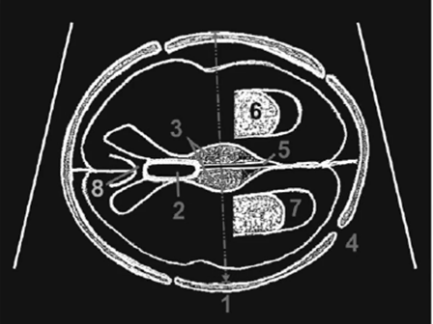
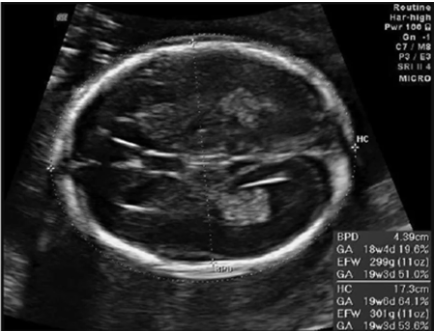
Improving lives together
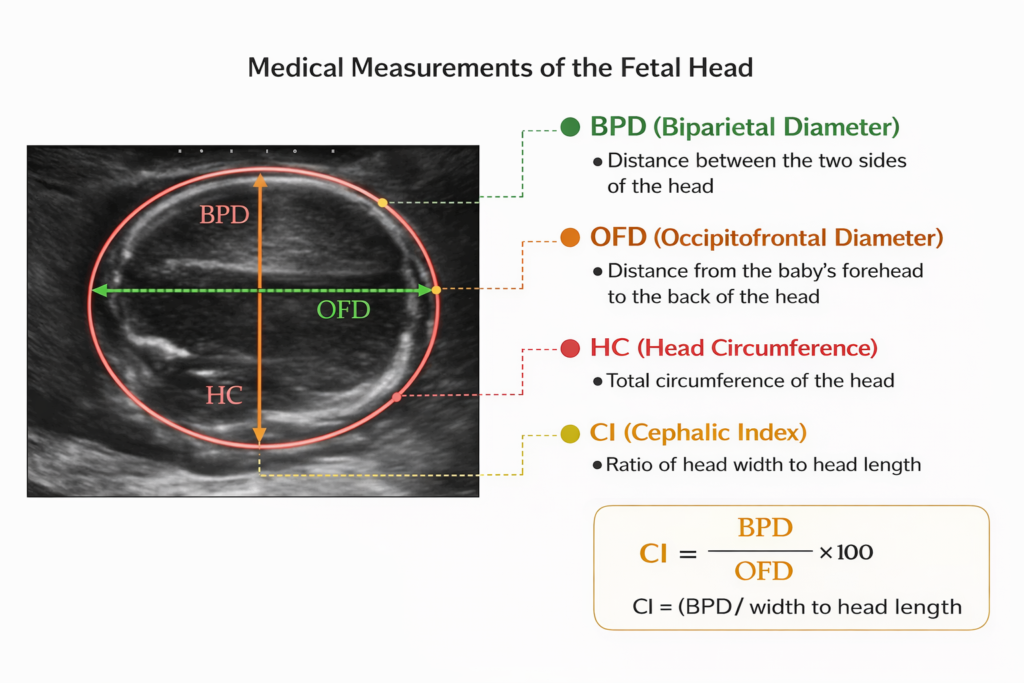
the fetal head region and automatically compute key biometric parameters such as Biparietal Diameter (BPD), Occipitofrontal Diameter (OFD), Head Circumference (HC), and Cephalic Index.
OBJECTIVES
- To develop a deep learning–based segmentation model for accurate extraction of the fetal head region from ultrasound images.
- To automatically compute key fetal head biometric parameters from the segmented region, including Biparietal Diameter (BPD), Occipitofrontal Diameter (OFD), Head Circumference (HC), Cephalic Index (CI)
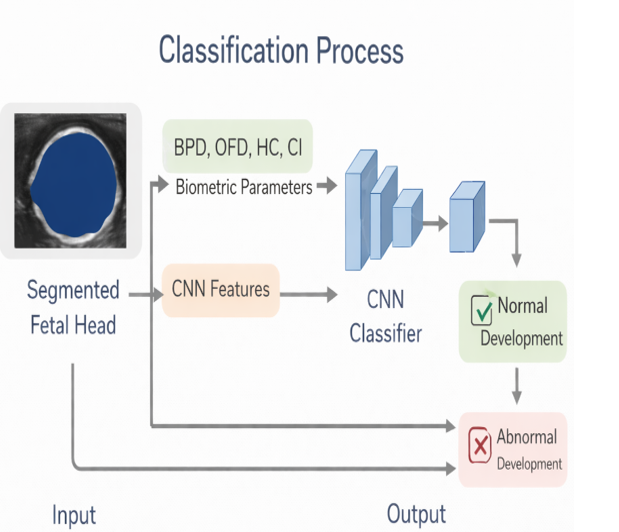
- To design a classification model that combines biometric parameters and, CNN-based image features
to detect normal and abnormal fetal head development.
METHODOLOGY
The proposed methodology follows a segmentation-driven deep learning pipeline for fetal head parameter extraction and abnormality detection from ultrasound images.
1.Data Acquisition
Ultrasound images of the fetal head are collected from publicly available datasets (such as HC18) or clinical sources. The dataset includes labeled images containing fetal head boundaries and corresponding biometric measurements.
2.Preprocessing
Preprocessing steps are applied to improve image quality and model performance:
- Noise reduction using filtering techniques
- Image normalization and resizing
3.Fetal Head Segmentation
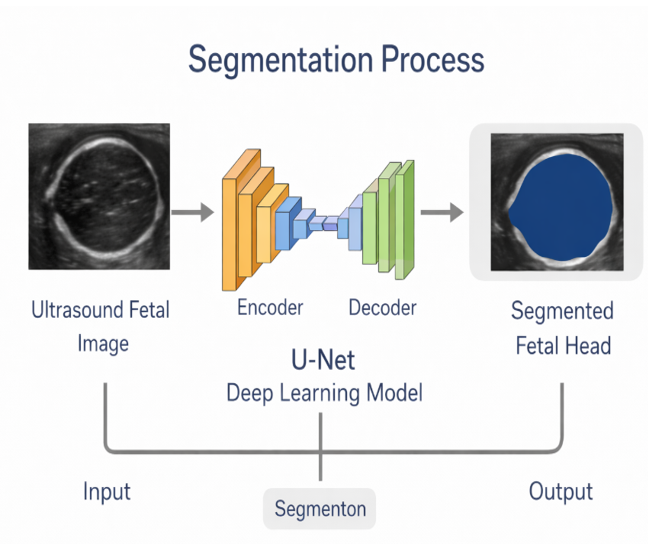
A deep learning model, typically U-Net or an enhanced variant (Attention U-Net / Residual U-Net), is trained to segment the fetal head region from ultrasound images. The model learns pixel-level features to accurately distinguish the head boundary from the background.
4.Head Parameter Extraction
After segmentation, geometric methods are applied to extract fetal head parameters:
- Head Circumference (HC)
- Biparietal Diameter (BPD)
SEGMENTATION
• Segmentation is used to automatically extract the fetal head region from the ultrasound image.
• A U-Net deep learning model is used because it is well-suited for medical image segmentation.
• The encoder extracts important features and edges, while the decoder reconstructs the head boundary to produce a segmentation mask.
• This mask removes background regions and isolates the fetal head with accurate contour detection.
• The segmented head region is then used for computing BPD, OFD, HC and Cephalic Index with improved reliability.
Purpose of Segmentation
✓ Reduces operator dependency
✓ Eliminates manual tracing errors
CLASSIFICATION
• The classification module is used to determine whether the fetal head development is Normal or Abnormal.
• The system combines biometric parameters (BPD, OFD, HC and Cephalic Index) with CNN-based image features for better decision accuracy.
• These features are given as input to a Convolutional Neural Network (CNN) classifier.
• The CNN learns growth patterns and deviations in fetal head structure and measurements.
• Based on learned features, the model classifies the fetal head into Normal Development or Abnormal Development.
Purpose of Classification
✓ Supports early prenatal screening
✓ Reduces manual interpretation dependency